Cory Sandhagen's Kneebar Injury Is a Hard Lesson for BJJ
Every BJJ practitioner who has ever hesitated half a second too long in a kneebar should look at Cory Sandhagen's leg this week. The bantamweight contender lost a unanimous decision to Mario…
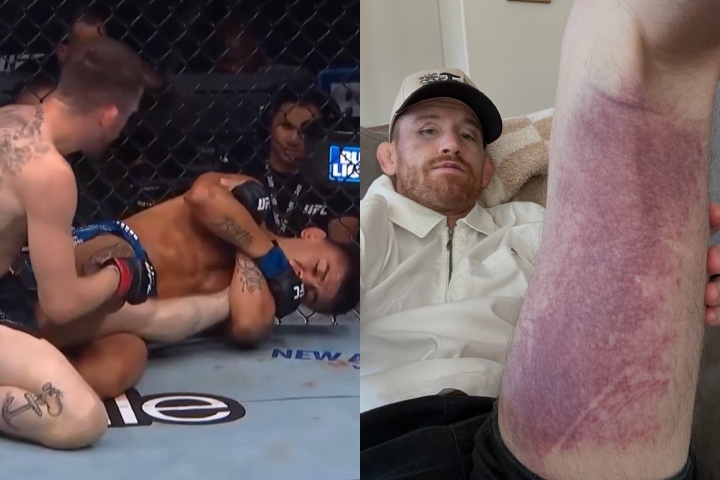
Every BJJ practitioner who has ever hesitated half a second too long in a kneebar should look at Cory Sandhagen's leg this week. The bantamweight contender lost a unanimous decision to Mario Bautista at UFC 329 — all three judges had it 29-28 — but the fight really turned near the end of the first round, when Bautista attacked a Suloev stretch and rolled it into a kneebar. Sandhagen never tapped. He also never walked right again for the rest of the night.
On Monday he posted a photo of the back of his leg — a deep, ugly bruise blooming across the hamstring — and confirmed he's booked for an MRI this week. See Sandhagen's post on Instagram; it's the kind of image that makes every leg locker in your gym wince in recognition.
"Pretty sure the knee bar tore my hamstring in the first (getting MRI this week). It kept locking out weird if I did certain things," Sandhagen wrote in the post, as reported by BJJEE. He was visibly limping back to his corner from that point on, fought two more rounds on the damaged leg, and got dropped in the third as Bautista sealed the win.
The submission that scores even when it doesn't finish
Here's the detail worth sitting with: the kneebar didn't finish the fight, and it still decided it. Sandhagen himself scored it that way — he conceded the first round to Bautista largely on the strength of that attack, felt he won the second despite the leg, and then couldn't hold the same pace in the third.
Jiu Jitsu people sometimes talk about submission attempts in MMA as all-or-nothing gambles — you either get the tap or you've burned energy and given up position. Sandhagen's leg is the third outcome we don't talk about enough: the attempt that doesn't get the tap but takes something with it anyway. A deep kneebar loads the knee joint, but the hamstring is fighting the extension the whole way — and when a fighter refuses to tap and explodes out instead, that muscle is often what pays the bill. The damage in a leg attack frequently happens before the moment anyone would call a finish.
That's also what makes the Suloev stretch such a quietly nasty entry. Named for Amar Suloev, who used it in the early 2000s, it's essentially a standing hamstring attack against an opponent trying to stand out of back control — and it chains naturally into the kneebar, exactly the way Bautista played it. It's a sequence straight out of a modern no-gi Brazilian Jiu Jitsu curriculum, showing up at the highest level of MMA and doing fight-ending damage without a single tap.
What the average Jiu Jitsu practitioner should take from this
Sandhagen is a professional with a title picture to think about, a cage to survive in, and every incentive to gut it out. You, rolling on a Tuesday night, have none of those incentives — and this is where his injury becomes genuinely useful to the rest of us.
Tap earlier than feels dignified in straight leg attacks. Kneebars, Suloev stretches, and their cousins don't give you the long negotiation window an armbar sometimes does. If the position is locked and the extension is coming, the heroic escape attempt is usually the mechanism of injury, not the alternative to it. Sandhagen "escaped" the kneebar in every sense that matters on a scorecard — and may have torn his hamstring doing it.
And if you're the one attacking: in the training room, that same speed is your responsibility. Catch-and-release exists in leg lock training for exactly the reason Sandhagen's Instagram makes vivid. The gap between "training partner" and "MRI appointment" is smaller in these positions than almost anywhere else in jiu-jitsu.
Where this leaves Sandhagen
To his credit, there wasn't an ounce of excuse-making in the post — he congratulated Bautista, called him well prepared, and said flatly that at the top you have to fight near perfect to win. The MRI this week will tell him how long the road back is. Hamstring tears are unglamorous injuries with stubborn timelines, and at 34, in a stacked bantamweight division, time matters.
For the rest of us, the takeaway costs nothing but pride: the tap is a training tool, and the leg you protect tonight is the one you roll on next month. Be the person in your gym who learns that from Sandhagen's MRI instead of your own.
See you on the mats.
Original report via BJJEE.