Mike Davis's Wrestling Rant Missed the Jiu Jitsu in His Own Fight
Mike Davis lost a decision at UFC Abu Dhabi over the weekend and used his post-fight interview to torch wrestling as a style, closing with slurs BJJEE had to censor in its own headline. It was an…
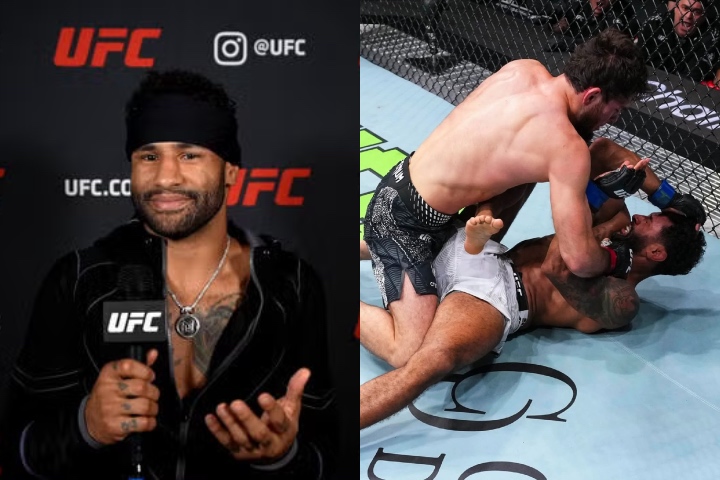
Mike Davis lost a decision at UFC Abu Dhabi over the weekend and used his post-fight interview to torch wrestling as a style, closing with slurs BJJEE had to censor in its own headline. It was an ugly way to describe a loss, and it buried the one detail from the fight that actually matters to a BJJ audience: Davis had a real jiu jitsu answer sitting in his own guard, and he only found it for a few seconds.
Davis dropped a unanimous decision to undefeated Tajik grappler Nurullo Aliev, with all three judges scoring it 30-27. Aliev took him down early, held top position through most of round one, and kept returning him to the mat every time Davis scrambled back to his feet. It was a clinic in cage wrestling, not a robbery — Davis himself ruled out illness as an excuse afterward, saying he'd felt fine physically despite being sick that week. His frustration was with the style of fight itself, not the judging.
The moment worth watching wasn't the rant
Buried in round two of that fight is a genuinely instructive sequence for anyone who trains Brazilian Jiu Jitsu: Davis, working off his back against a bigger, control-heavy wrestler, briefly locked in a triangle choke before Aliev worked free and reset inside his guard. It didn't finish, and it didn't change the outcome. But it was the one moment in three rounds where Davis was doing something to Aliev instead of something happening to him — and it came from bottom position, using exactly the kind of guard game jiu jitsu spends years building.
Watch the full fight breakdown on YouTube to see how quickly Aliev shut that door and reestablished pressure. That's the real lesson buried under the rant — not that wrestling is unfair, but that a stalled-out submission attempt from the bottom is still infinitely more dangerous than lying there waiting for the horn.
This is a pattern worth naming, because it isn't new. Strikers who get taken down and held there have been complaining about "boring" wrestling since the first UFC events, and the complaint almost always comes from the same gap: they don't have the guard to make the position expensive for the man on top. A wrestler who can get a takedown and simply sit in top position all night is only unbeatable against an opponent whose Jiu Jitsu stops at "get back to my feet." Against a real guard — one built to threaten sweeps, back takes, and submissions from underneath — top control gets a lot more dangerous to hold onto, and a lot less appealing to chase.
Why this happens to strikers specifically
Brazilian Jiu Jitsu has always framed guard as an equalizer against bigger, stronger opponents, and modern MMA proves the point in the other direction too: fighters who never developed a bottom game get exposed the moment a wrestler decides to simply sit on them. Gordon Ryan, the Ruotolo brothers, and Mikey Musumeci built their names by making the bottom position a place opponents fear rather than a place they wait to escape from. That's not a stylistic preference — it's the entire logic of the art. A fighter with three rounds of BJJ-caliber guard retention doesn't need to out-wrestle a wrestler; he just needs to make every second on top of him a live threat.
None of that excuses the language Davis used to describe the loss. Calling a style of fighting a slur doesn't make the style less effective, and it says more about the frustration of being controlled for fifteen minutes than it does about wrestling itself. If anything, the outburst underlines how little credit grappling gets when it works exactly as designed — control, positional dominance, and patience, the same tools BJJ practitioners drill every night on the mats, just applied inside a cage instead of a gi.
Davis says he's done facing wrestlers and wants a striking matchup instead. Fair enough — that's his career to manage. But the fix for getting smothered by a wrestler was never "stop fighting wrestlers." It's the same fix it's always been in Jiu Jitsu: build a guard dangerous enough that top position stops feeling safe. Davis had it for a few seconds in round two. The rest of us get to spend our training time building it for good. See you on the mats.
Original report via BJJEE.