BJJ Blue Belt Charged With Manslaughter Over a Rear Naked Choke
A story out of Perth this week is a hard one for the BJJ world to read, and an important one. A 26-year-old junior doctor and Jiu Jitsu blue belt named Christian Jack Joseph has been charged with…
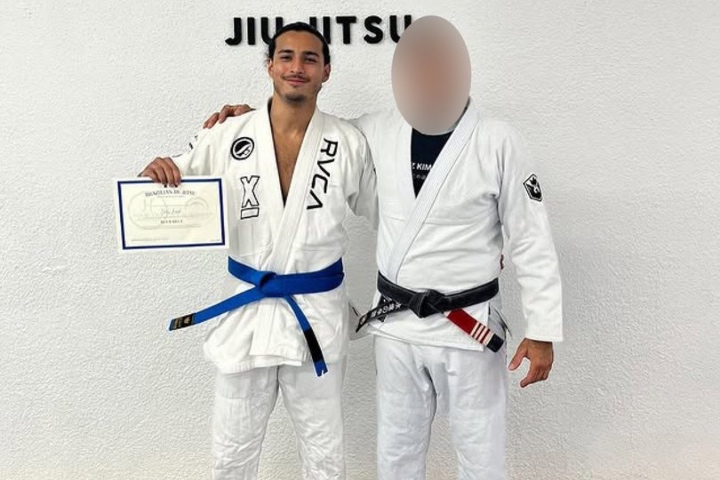
A story out of Perth this week is a hard one for the BJJ world to read, and an important one. A 26-year-old junior doctor and Jiu Jitsu blue belt named Christian Jack Joseph has been charged with manslaughter after a 63-year-old man died during an altercation, with prosecutors alleging the older man was held in a rear naked choke for close to two minutes. Joseph was refused bail and remanded in custody. Nothing about it is resolved — the courts will do their work — but the shape of it is enough to make anyone who trains stop and think.
According to the report, Joseph had been out celebrating a birthday in Fremantle and returned to a friend's house around 1:30am. He allegedly spotted a man looking through a window, called out, and the situation escalated fast: a chase, a tackle, and a choke held on the ground for roughly one minute and fifty seconds. The man lost consciousness. Joseph reportedly performed CPR while a friend called emergency services, but the 63-year-old later died in hospital. His lawyer has argued self-defense and described a client "dedicated to saving lives." The Homicide Squad is investigating.
We're not here to try the case. We're a Jiu Jitsu publication, and there's a Jiu Jitsu lesson buried in this tragedy that every one of us should carry off the mats — because the thing at the center of it is a technique most of us drill every single week.
The rear naked choke does exactly what it's built to do
In the academy, the rear naked choke is almost gentle. You sink it, your partner taps, you let go, you reset. The whole ritual runs on a shared agreement: the tap ends it. That agreement is invisible right up until it's gone.
A blood choke works by cutting circulation to the brain. Applied cleanly, it can put someone out in seconds. That's why it's so beloved in training — it's decisive and, in a controlled room with an honest tap, remarkably safe. But the same mechanism that makes it a clean submission on Tuesday night makes it genuinely dangerous the moment there's no tap being honored, no partner watching your grip, and no referee to jump in. Held long enough, unconsciousness is not the finish line. A minute and fifty seconds is a very long time to hold a choke on someone who can no longer signal, no longer resist, and can no longer protect their own airway or circulation.
Blue belt is a meaningful rank. It means the choke is real, that the hands find the position without thinking. That competence is exactly what raises the stakes outside the gym. A skill that ends a roll cleanly can end a life when the guardrails that make the mats safe — the tap, the ref, the mutual consent — are all absent.
What a trained grappler carries off the mats
There's an old line in self-defense circles that your hands become the "weapon" the moment you're trained, and courts in a lot of places genuinely weigh that. A grappler who knows how to finish a choke is not a bystander who threw a lucky punch. Fair or not, that competence can shape how an incident is judged after the fact — and it should shape how we behave before one ever starts.
The uncomfortable truth this case surfaces is that Brazilian Jiu Jitsu sells itself, correctly, on real-world effectiveness. We tell newcomers it works. It does. But "it works" and "you should use it" are two completely different sentences, and the gap between them is where stories like this live. Control is not just the ability to finish. It's the ability to recognize when the fight is already over — when someone has stopped resisting, gone limp, gone quiet — and to let go. On the mats that judgment is handed to us for free by the tap. Off the mats, nobody hands it to you. You have to own it yourself, in the dark, at 1:30am, with adrenaline screaming.
The reminder underneath the headline
Most of us will never be within a mile of a moment like this, and that's worth saying plainly. But the value in a story this grim isn't ghoulish — it's that it re-anchors what our skill actually is. A choke is not a party trick or a bar-fight equalizer. It's a tool that can take a life, wielded by people who, by design, are very good at applying it.
De-escalate. Disengage. Get to safety. Those are the first three tools in any honest self-defense curriculum, and the choke is somewhere much further down the list — a last resort, applied only as long as necessary and not one second longer. If your academy never talks about the legal and moral weight that comes attached to your blue belt, it's a conversation worth starting. The techniques we love come with responsibility baked in.
Our thoughts are with the family of the man who died, and with everyone touched by a night that went so wrong. There's a version of this story that stays a lesson and never becomes a headline. Train hard, keep your head, and know when to let go.
See you on the mats.
Original report via BJJEE.