Tai Otoshi with Travis Stevens for BJJ
When this Travis Stevens breakdown of tai otoshi first ran, most BJJ players filed judo's body drop under "beautiful, but not for me" — a throw for people who'd spent twenty years on tatami, not…
Words: Jiu Jitsu Style
When this Travis Stevens breakdown of tai otoshi first ran, most BJJ players filed judo's body drop under "beautiful, but not for me", a throw for people who'd spent twenty years on tatami, not for gi players who planned to sit down the moment the referee said go. A decade later the standup game has come roaring back into Jiu Jitsu, and tai otoshi has quietly become one of the most sensible throws a grappler can steal. Stevens, Olympic silver medallist in judo at Rio 2016 and a BJJ black belt out of the Renzo Gracie Academy under John Danaher, remains one of the very few people qualified to explain why.
Watch it: Travis Stevens' tai otoshi.
That dual résumé is the whole point. Stevens fought at the highest level judo has, then earned his black belt training alongside the Danaher group as it reshaped modern grappling. He isn't a judoka guessing at what will survive contact with a Jiu Jitsu match, and he isn't a BJJ coach parroting a throw he learned from a highlight reel. When he picks a technique to show a room full of gi players, it's because he has felt exactly where judo and jiu jitsu overlap, and tai otoshi sits right in the middle of that overlap.
Why tai otoshi suits a Jiu Jitsu player
Tai otoshi is judo's body drop: you break your opponent's balance towards their front corner, step across their body, extend your leg as a barrier across their shin, and steer them over it with your hands. Notice what's missing from that description, there's no lift. You never load your opponent's weight onto your hips or shoulders the way you must for a hip throw. They trip over a fence you've built while your hands drive the rotation, which is why the throw works for lighter players against bigger opponents and why it doesn't cost you much when it fails.
That low cost is what makes it such a natural fit for BJJ. The nightmare scenario for a gi player attempting judo is committing everything to a big turning throw, stalling halfway, and donating their back. Tai otoshi keeps you on your feet the whole way through. If the entry is there, your opponent hits the mat in front of you with your grips still attached, and you follow them straight into side control or a knee ride. If it isn't there, you step back out and you've lost almost nothing. Add in that the throw actually works well against the bent-over, defensive posture half the Jiu Jitsu world adopts in the grip fight, and it's hard to name a throw with a better effort-to-risk ratio.
The details that make it work
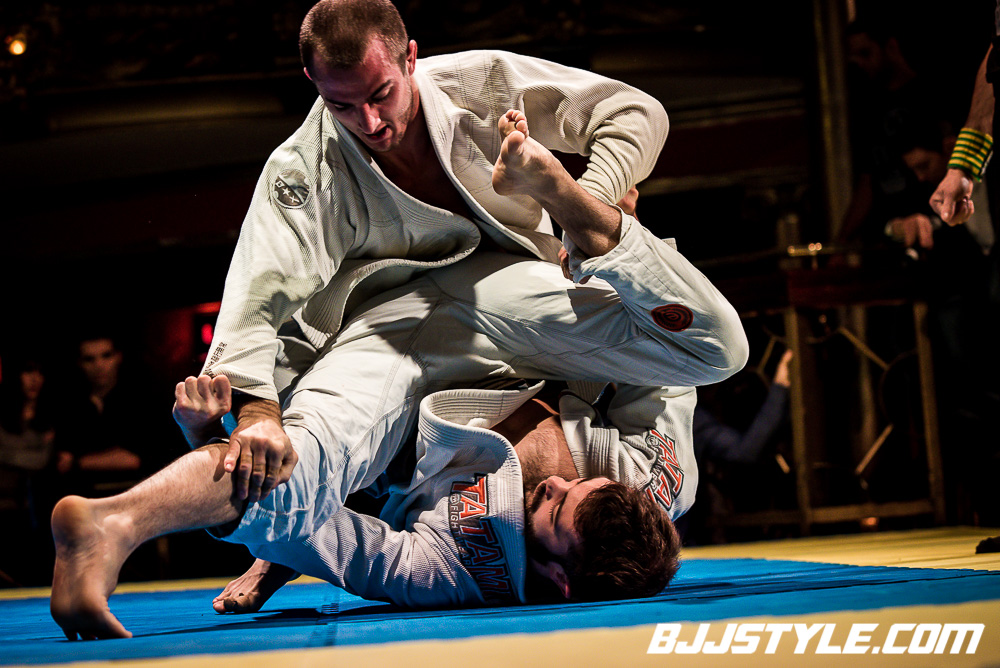
Watch Stevens hit it and the throw looks like a small thing, a step, a snap of the hands, and someone's feet are above their head. That smallness is the skill. The kuzushi comes first and it comes hard: a sharp pull towards the front corner so your opponent's weight is already traveling over their toes before your feet start moving. The entry is a quick two-step across their body, hips low, and the blocking leg goes across the shin, low on the leg, toes on the mat, knee soft. Never block high near their knee; that's how both of you get hurt. And the finish is all hands and rotation: you're steering them over the barrier like turning a wheel, not reaping or kicking.
The mistakes are the ones every BJJ player makes in month one. Throwing without the off-balance, so the opponent simply steps over your outstretched leg. Standing tall on the entry instead of dropping the hips, which turns a throw into a shove. Planting the blocking leg stiff with the knee locked, the single error Stevens is most emphatic about, because a stiff leg with a falling body across it is a knee injury waiting to happen. Keep the toes on the mat, keep the knee flexed, and let the hands do the throwing. Drill it slow until the step pattern is automatic, because at speed there's no time to think about feet.
The takeaway hasn't changed
The argument this clip was quietly making has aged well. Between ADCC's rewarding of genuine takedowns and the IBJJF's tightening grip on stalling before the guard pull, competitive Jiu Jitsu now takes the standing phase seriously in a way it simply didn't a decade ago. The Ruotolo brothers will happily fight a whole final on their feet, Ffion Davies brings real throwing skill into the biggest women's matches in the sport, and Stevens himself has spent the years since Rio teaching judo to Brazilian Jiu Jitsu rooms full-time. The throws that once looked exotic on a magazine page are now on the Tuesday curriculum at ordinary clubs.
For the rest of us, the prescription is the same as it was. You don't need fifty throws; you need one or two that fit your grips and your body, drilled until the entry is free. Tai otoshi is one of the best candidates in the sport, low risk, no lift, and a landing that hands you the top position with your grips intact. Watch the footage with a notebook, steal the details, and if you can get to a judo class one night a week, go. Instructional apps and YouTube have made the studying easier than ever, but the feel of a real resisting grip fight is still earned on the mat. The standing phase of a BJJ match is either something that happens to you or something you do, and Travis Stevens remains one of the best people alive to teach you the second option.
See you on the mats.
Originally published in Jiu Jitsu Style, 27 September 2016. Refreshed for 2026.