Pan Am Training Camp with Atos Jiu Jitsu
By Kit Dale
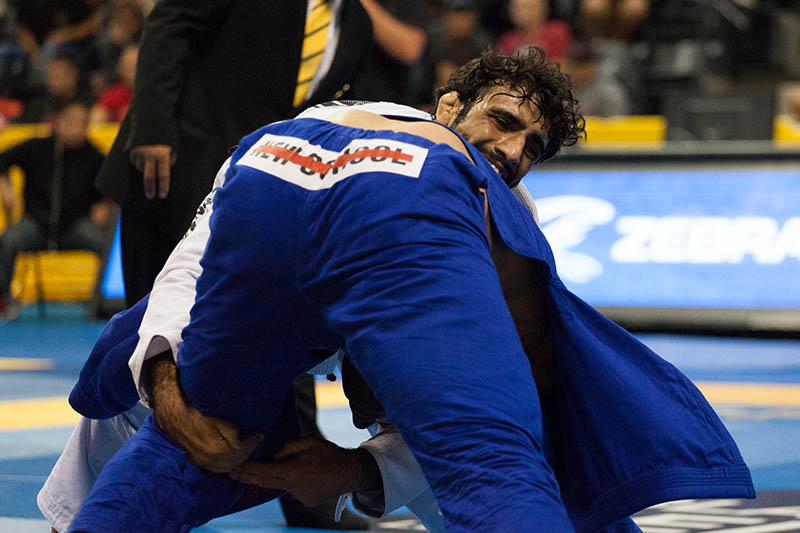
Kit Dale is one of Australia's most recognisable jiu jitsu personalities — a brown belt who picked up Brazilian National and WPJJC titles on his way up, and who has spent the years since coaching, joking around online, and arguing with the rest of the BJJ world about how we ought to be learning this stuff. The blog below was first written during his Pan Am training camp at Atos in San Diego. He's refreshed it here for 2026.
By Kit Dale
Dustin Brown and I had just wrapped up our first week of Jiu Jitsu training in San Diego at Atos, and we were sure glad we got that weekend off — the San Diego Trials had been held a few days earlier and we were ready to drop. It was our first proper rest before starting again on Monday and it was well needed and well deserved.
We landed in LA on a Monday and a few hours after that we already had our kimonos on, training with CIA Paulista co-founder and 7th degree black belt Professor Waldomiro Perez Junior (Rampage Jackson's BJJ coach) and 3rd degree black belt Professor Paulo Gaezze Junior at Geazze Academy in Huntington Beach. We trained in the morning, then again in the brown/black-only class at night. It felt good to sweat after sitting on a plane for thirteen hours. After class we drove out to our hotel in San Diego, slept, and got ready for our first morning at Atos.
Then we trained all week, morning and night, in the competition classes. It was a stunning opportunity to roll with the likes of Andre Galvao and a room stacked top-to-bottom with World and Pan champions. Whoever the room is on any given day — back then it was Galvao, the Mendes brothers before they moved up the road to AOJ, Chris Visentin, Marcos Souza, Mike Fowler — these are people most academies would pay thousands of dollars to fly in for a single seminar. At Atos, you just walk in and they're your training partners for six hours a day. Today the names on the door would be different — Kaynan Duarte, Tainan Dalpra, Lucas "Hulk" Barbosa, Patrick Gaudio — but the gig hasn't changed. World-class athletes, all in one room, all going hard.
The biggest thing I noticed was how unfit I was. At home, most people would have got the impression I was very fit, but the fact of the matter is it's easy to look fit when you're training with an inexperienced opponent. Out there at Atos there was nowhere to hide. Everybody was there to train and to train hard. We'd start the morning with a warm-up — lots of movement, lots of stretching — then go straight into high-intensity drilling. Most of that week we worked passing and sweeps, running through a whole sequence at speed for thirty minutes straight. Then a drink of water, and into specific training: one person in guard, the other passing, first one to submit or score points wins, swap. Thirty minutes of that, also at a high tempo. Then comp rounds: ten by six-minute rounds, starting from standing, one-minute breaks in between. On paper it doesn't sound like much. Then you remember who the opponent in front of you is, and it sounds completely different.
After training we'd warm down, stretch, then sit around as a group and talk through positions and questions. That part is gold. To have one of the best in the world right there in front of you, breaking down what just happened — and not being precious about it, having a laugh while he does it — that's the part you can't get from a video. It made the training not just useful but genuinely fun.
We did that twice a day, with strength and conditioning sessions sandwiched between. It really opened my eyes to what I had been calling hard training back home. I had a lot to work on if I wanted to keep up with the best in the world. Australia at the time didn't have enough people taking the sport that seriously, which made it tough to find training partners who could push you to the next level. (Eleven years later that's nowhere near as true — there's now a generation of Aussies running with the world's best, and academies in Melbourne, Sydney, and Perth that didn't even exist when I wrote this — but the principle still stands: your room is the ceiling on your game.)
A quick note on resources, because this is the part of a 2014 blog that ages the fastest. Back then, getting access to a Galvao or a Mendes meant getting on a plane. That's still the gold standard, and it always will be — film is no substitute for the speed and pressure of a great training partner — but the gap has narrowed. BJJ Fanatics, the instructional apps from basically every elite team, and the absurd amount of free coaching that lives on YouTube and Instagram now mean a brown belt in regional Australia can study a Galvao passing system or a Mendes guard at a level of detail we used to have to fly across the world for. Use that. But also, when you can, get on the plane.
I was lucky to have a gi sponsor at the time who covered the costs of the trip and supported me on the road to a black-belt world title. Without sponsors like that I wouldn't have been able to make any of this happen.
Also on a positive note from that week — fellow team-mate Dustin Brown won his division at the Abu Dhabi San Diego trials, winning all his fights by submission. Awesome work to see another Australian winning internationally.
Then we rested over the weekend and geared up for another week of hard training. Stay tuned for the next instalment.
Osssss,
Kit Dale
My background in Brazilian Jiu Jitsu
I'd been training in Brazilian jiu jitsu for three and a half years when I wrote this. Originally I played Australian rules football in Melbourne, where I grew up. I got into jiu jitsu after watching the UFC and thinking I needed to learn this to be able to protect myself.
After finding an MMA school I realised I much preferred the grappling side of it, and eventually found a jiu jitsu school. It was about the size of a large car and sat next to a train station. I was working full-time and still playing football, so I could only train twice a week for the first half year. Then I went to watch a local competition and that was it — I was hooked. I knew right then I wanted to be a black-belt world champion. Within the next year I'd dropped football training and was on the mats five times a week. After ten months I got my blue belt. I was very excited because I'd worked hard for it.
Once I had the blue, I felt I needed a bigger school with higher-level fighters. I found that at Peter de Been's academy in St Kilda. It was roughly an hour and twenty from my house. I trained there five times a week for a year, then finally quit my day job and started teaching privates to keep me from being broke. My father let me live with him for free and I taught a butcher who helped me out with food. My girlfriend Taryn also chipped in when I needed it. I got my purple and brown belt in that stretch. I was able to make brown in three years thanks to dedication and a complete unwillingness to take a day off. A handful of decent results helped my cause along the way.
By the time I wrote this I'd had 153 jiu jitsu matches and lost only three. A few of the credentials:
2x World Pro Champion
2011 Brazilian National Champion
10x Pan Pacific Champion
8x Australian Champion
2011
2x Melbourne International Open under 85kg and Absolute Champion (Brown)
2x Pan Pacific Brown belt under 85kg and Absolute Champion (Brown)
1x Brasileiro under 85kg purple belt champion
1x Abu Dhabi Pro Jiu Jitsu Gi World Cup champion under 83kg (Purple)
1x Abu Dhabi Pro Jiu Jitsu No-Gi World Cup silver under 86kg (Purple)
1x Abu Dhabi Pro Jiu Jitsu trials winner over 74kg (Purple)
1x Most Technical Male Award
4x Victorian State Jiu Jitsu Champion under 85kg and open weight (Purple)
3x QLD State Jiu Jitsu Champion under 85kg and open weight (Purple)
2010
2x Pan Pacific Champion (Purple)
1x Australian Elite Super Fight Champion
1x Abu Dhabi Pro Jiu Jitsu World Cup champion under 83kg (Blue)
4x Victorian State BJJ Champion (Blue)
1x Most Technical Male Award
4x Australian Cup Champion (Blue)
1x NSW State BJJ Champion (Blue)
2009
1x Abu Dhabi Pro Jiu Jitsu World Cup Trials champion open weight (Blue)
3x Pan Pacific Champion (Blue)
1x Victorian State BJJ Championships champion (Blue)
Originally published in Jiu Jitsu Style by Kit Dale. Refreshed for 2026.