Kit Dale's Berimbolo Counters: A BJJ Guard Lesson
When we first ran Kit Dale's berimbolo counter clip in January 2017, we let the footage do the talking, because Kit's whole approach to Jiu Jitsu made a caption feel unnecessary. Here was an…

Words: Jiu Jitsu Style
When we first ran Kit Dale's berimbolo counter clip in January 2017, we let the footage do the talking, because Kit's whole approach to Jiu Jitsu made a caption feel unnecessary. Here was an Australian black belt who'd built an international competition career on De La Riva guard and inversions, showing the room the other side of his own game: how to stop the roll he'd spent years perfecting. A decade on, the clip is still worth a rewatch, because the berimbolo hasn't gone anywhere and neither has the panic it causes in anyone who hasn't drilled the answer.
The problem the berimbolo creates is almost entirely about tempo. Your opponent takes a De La Riva hook, off-balances you, and starts to invert underneath your base. The instinct is to chase the spin — to follow the hips as they roll, trying to stay square. That instinct is exactly what makes the berimbolo work. Kit's counters all point the same direction: stop treating the roll as an emergency and start treating it as information. The moment your opponent commits their weight to the inversion, they've also committed their neck, their base, and their ability to change direction. Every good counter lives in that trade.
Why Kit's BJJ counters still hold up in 2026
The berimbolo went from a curiosity to a cornerstone of modern Brazilian Jiu Jitsu in the years since this clip first aired, and the counters have had to grow up alongside it. The Ruotolo brothers turned the position into a highlight reel, hitting berimbolos and back takes against black belts who knew exactly what was coming and still couldn't stop it. That's the real shift since 2017: the roll is no longer a surprise, so the counter can't be either. Competitors now drill the stop the way they drill the sweep — as a rehearsed sequence, not a reflex.
What hasn't changed is the mechanics Kit was pointing at. Smash the hips forward before the inversion finishes and the roll stalls before it starts. Free the trapped leg by rotating it out rather than yanking it, and the whole setup collapses with it. Refuse to follow the spin with your shoulders — stay heavy, square your hips to the mat, and let your opponent's own momentum carry them somewhere they didn't plan to go. None of this is new information. It's the same handful of details Kit was demonstrating, just with a decade of high-level Jiu Jitsu proving they still work against the best berimbolo players alive.
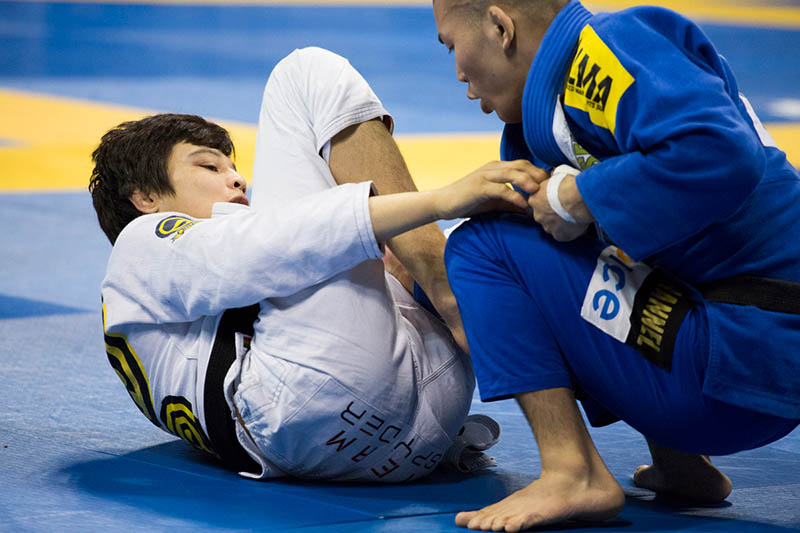
The lesson underneath the counter
The deeper point in Kit's clip was never really about the berimbolo at all. It's about what happens when you meet an unfamiliar attack with patience instead of panic. Kit built his whole career on doing things his own way — famously skeptical of straight repetition drilling, always looking for the concept underneath the technique — and his berimbolo counters are that philosophy in miniature. Understand why the position works and the stop reveals itself. Chase the symptom and you'll be chasing legs all night.
Drill it from both chairs. Get comfortable initiating the roll so you understand exactly where your training partner's weight has to go, then flip seats and drill stopping it before it starts. Watch how Mikey Musumeci and Ffion Davies both refuse to give up their base even under heavy grip pressure, and you'll see the same principle Kit was teaching in 2017 running underneath elite Jiu Jitsu today. The berimbolo is still one of the best tools in the sport. It's just no longer a mystery — and it never should have been.
See you on the mats.
Originally published in Jiu Jitsu Style, 10 January 2017. Refreshed for 2026.