How to Triangle Larger Opponents in BJJ
Ever get stuck trying to triangle bigger opponents in BJJ? When we first ran this post in August 2016, that question and one more line — Uncle Renzo has the answer — was the whole article, sitting…
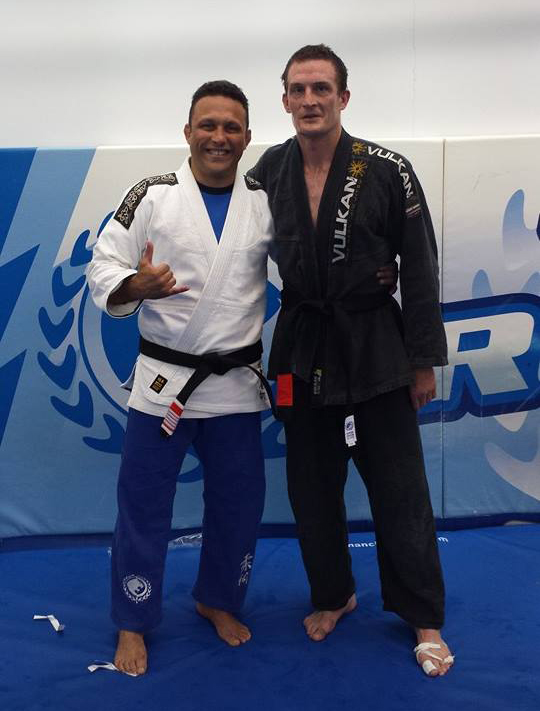
Words: Jiu Jitsu Style
Ever get stuck trying to triangle bigger opponents in BJJ? When we first ran this post in August 2016, that question and one more line, Uncle Renzo has the answer, was the whole article, sitting under a plug for Issue 33 with Marcus 'Buchecha' Almeida on the cover. That was the house style of the era: point at a Renzo Gracie clip, get out of the way, and let one of BJJ's great teachers do the talking. Ten years on, the question hasn't gone anywhere. Every gym still has a lanky blue belt throwing up triangles that work beautifully on everyone except the one training partner built like a fridge. So it's worth spelling out what the clip was really pointing at.
Why Bigger Opponents Shut Down Your Triangle
Be honest about the problem first. When you throw a triangle on somebody your own size, you can get away with a lot, a square angle, a lazy lock, an arm left in the wrong place, because your legs are long enough and their neck is narrow enough that the choke arrives anyway. Against a larger opponent, none of that slack exists. Their shoulders are too broad for your knee-to-hip lock to close around, their posture is strong enough to stand straight up out of a sloppy entry, and if you hang on stubbornly to a half-finished triangle they'll answer with every big man's favorite reply: the stack, driving your knees into your own nose until you let go.
The instinct most people follow at that point is to squeeze harder. That's exactly backwards, and it's the instinct Renzo's clip was there to correct. The triangle is not a strength contest between your legs and their neck, if it were, you'd never triangle anyone bigger than you, and jiu jitsu history is full of people doing precisely that.
The Answer Is Angle, Not Squeeze
What makes the triangle work on a bigger body is geometry. Squared up to your opponent, you're asking your legs to reach around the widest part of them, both shoulders at once. Cut an angle so you're perpendicular, swing your body off to the side of the trapped arm, and suddenly the choke only has to close around a neck and one shoulder. Same legs, dramatically less distance to cover.
Everything else in the classic advice flows from that. Break their posture down and keep it down, because a big opponent who gets upright gets everything back. Control the trapped arm and feed it across the neck, so their own shoulder becomes half the choke. Underhook the leg or grab your own shin to hold the angle while you adjust, rather than lying flat and hoping. And be patient with the lock itself, a high, open-legged control of the head and arm is safer than snapping a shallow figure-four you can't finish. None of this is exotic. It's the difference between a triangle that traps a man and a triangle that annoys him.
The Triangle Against Size in Today's Jiu Jitsu
If anything, the years since 2016 have made the point more emphatically. Watch any absolute division and you'll see smaller competitors calmly wrapping triangles around athletes with thirty kilos on them, because angle and posture control don't care about the weight class. Mikey Musumeci has built a career finishing chokes on whoever's put in front of him. Ryan Hall turned the triangle into a system precise enough to teach from any entry. And the room Renzo built, the New York academy whose basement produced John Danaher, Gordon Ryan and a generation of submission hunters, has spent two decades proving that mechanics beat mass when the details are right.
The tools around you have changed, too. In 2016 you got two sentences and a video; in 2026 there are full instructionals on triangling bigger bodies a tap away on BJJ Fanatics and YouTube. But the homework is the same as it ever was. Grab the biggest willing partner in your gym, start from a locked triangle, and drill nothing but cutting the angle and breaking posture until the stack stops arriving. Uncle Renzo had the answer a decade ago. It still works.
See you on the mats.
Originally published on Jiu Jitsu Style, 11 August 2016. Refreshed for 2026.