Hardcore Legend Harley Flanagan's BJJ Black Belt Journey
What inspired you to start jiu jitsu?
**Words: Richard Baker**
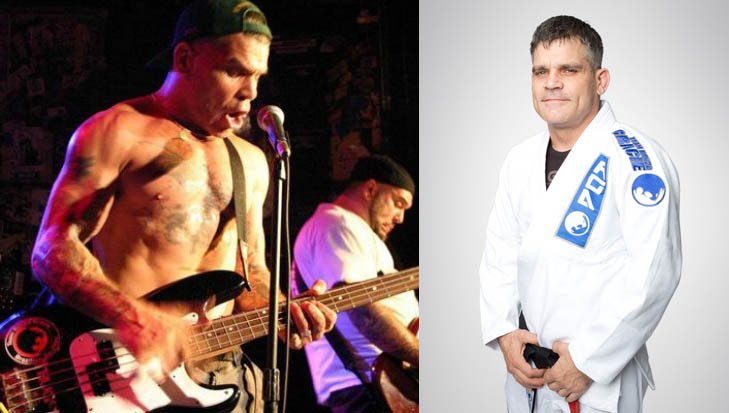
For this edition of White Belt Fever, I had the pleasure of sitting down with Renzo Gracie BJJ black belt Harley Flanagan. For those of you who don't know, Harley started a band in the mid-80s called the Cro-Mags, whose impact on hardcore music was nothing short of stupendous. I read his book — Hard-Core, A Life of My Own — and along the way confirmed he'd been quietly putting in serious mat time. At which point I knew I had to track him down. Harley is nothing short of a colourful soul who seems to have lived a thousand lives, and I was itching to talk about his time as a white belt — how a man with so much going on still managed to train and progress in Jiu Jitsu.
What inspired you to start jiu jitsu?
I remember seeing UFC 1 and 2 on VHS, renting them from a Blockbuster, and I had no idea what the f\\k it was. I remember looking at the box and thinking what the f\\k is this? The photos on the box looked like real fights, people were all covered in blood, and I'm thinking to myself, is this fake wrestling s\\t or something? It looks like it might be real, so I rented it, took it home and I was blown away. Royce was submitting all these big dudes, and I was blown away. I've had hundreds of fights in my life, I mean, I couldn't even put an estimate on how many, but I had never seen anything like an armbar or a kimura or any of this s\\t. So I made up my mind right then: if I ever get the chance to train with one of these guys, I'm going to pursue it. I'd punched a million people, kicked them, head-butted them and all the other things you do in a fight, but I had never seen anything like that. I was actually in LA at the time. I came back to New York in winter '95, met with Renzo in early '96, started training with him, and never turned back.
How did you meet Renzo Gracie?
When I came back to New York I was looking for a place to learn jiu jitsu. I looked at a couple of traditional jiu jitsu academies and even some judo academies because I was just looking to get myself started down that path. Every day I'd go up to the magazine stores and browse through the racks — Black Belt and all the others — and go through all the ads in the back, because I knew sooner or later one of these mother\\kers had to come to New York. BJJ already owned the West Coast, and I knew it was only a matter of time. New York City is one of the centres of the civilised world. It was going to arrive eventually.
One day I opened up the back of one of those magazines and saw an ad for Gracie Kucuk. I had no idea what Kucuk was — turns out Kucuk was Renzo's partner at the time. So there were two black belts teaching, Renzo and Kucuk, plus a brown belt and a purple belt from Brazil, and those were our instructors. That was the beginning of it. Renzo only had a dozen students or so when I first started training with him, and he was such a warm person. So welcoming and friendly. The guy is one of the coolest people you'll ever meet. You get that vibe right off the bat. I became close friends with him and there's been no turning back. I've been friends with him now for thirty years, I teach at his academy here in New York City, and I consider him a very close friend.
A lot of white belts claim they don't have time to train, or can't get into the gym as much as they say they'd like to. How did you balance getting mat time in while always being on the road with a band?
I was gigging a lot, but it's like anything else — you've got to be consistent no matter what you're doing. I'd go on tour for a few months, come back, jump right back on the mats and start again. The only thing was that my cardio would suck for a bit because I'd been out on the road, so I'd come back and get my ass kicked for a few weeks.
I'd still remember the mechanics of the techniques — it was just a matter of my body catching up. It did take me a little bit longer than a lot of my friends to get my black belt because I had such a busy life. But consistency is the key to anything. Find the time, man. If you are really dedicated to something you will find the time.
Even when I was on the road I would stop in academies in different states and different places and different countries. I trained every time I was in Japan when I was just a blue belt. I don't know if you know much about our fan base, but we have a lot of knuckleheads and a lot of gangbangers and wannabe tough guys who were into our music. A lot of gang members would come to the shows, and at sound check they'd want to test me. Everybody knew I was into training so everybody wanted to f\\k around. Sometimes I'd line them up and just submit 'em. I'd say, okay, let's see if you can pass my guard, let's see if you can take me down. I'd find little ways to entertain myself like that. At the same time I was spreading the word of Brazilian Jiu Jitsu, because in the mid-90s it was still pretty underground. There were a lot of non-believers out there who didn't think this s\\t worked. I made sure everywhere I went that I proved it does, and everywhere I played I always rocked my Renzo Gracie shirts and really spread the word. I'm a believer, ya know.
That's one of the coolest things about BJJ now — you can just open Instagram or a gym's WhatsApp group and ask if there's anywhere to train wherever you're going.
Yeah, it's a different world now, and it's a lot more open to outsiders. In the early days it had a harder vibe. If you went into an academy and you were from somewhere else it was a little bit more clique-y. I don't want to say it had a gang mentality, but yeah, it was way tougher in the old days because it wasn't as family-friendly. The people who trained were either MMA fighters or bouncers or just people who liked to fight and often got into fights. You didn't have a lot of kids or women training. Now you come into the academy and of course you have MMA fighters, but you also have just regular people — doctors, lawyers, construction workers, kids, women, everyone. It's all kinds of people who are interested in this sport. Back then it was really just people who were into fighting.
What were your biggest challenges as a white belt? A lot of people starting out seem to struggle with ego, physical fitness or just making time for training. What did you find was a big obstacle?
Ego always gets in the way, you know, because when you get to a certain point you start thinking that you know techniques, but you're still being forceful and you're still using muscle because you haven't really got it down that well yet. I remember right when I first started I thought I was doing good because I was smashing people on the mats. Renzo shouts over to me — he probably wouldn't say this to me now because we're all much more civilised — but I remember him saying, "Hey Harley, what's the difference between a blue belt and a bucket of s\\t?" And I'm like, "uhh, I dunno." (I was a blue belt at the time.) And he goes: "The bucket." I laughed, but didn't quite understand it as much as I do now. You get to a place where you start thinking you're showing people up, that you're a hard-ass, your pride starts to swell up because you're getting the submission, you're passing the guard, you're dominating. The fact is the guys you're dominating and passing don't know s\\t yet. It's one of the really formative stages of Jiu Jitsu, but man, that was funny as hell.
If you could change one thing about your training in the old days, and your journey, would you?
Nah, you know something, I was really lucky — I started off with some of the best. Early on at the academy we had Rodrigo Gracie, Matt Serra, his brother Nick, John Danaher, all these guys who were real beasts. I wouldn't change a thing. Sure, I look back at some old photos and old footage and I'm like, "Man, posture, where's your f\\kin' posture?" You know, little stuff. I'd have probably cut my hair sooner — when I first started training I had long-ass hair and probably should have lopped that off — but really, no changes, no regrets. I'm really blessed and fortunate that I'm part of this world of Jiu Jitsu. It started off all about fighting for me, and I can honestly say that at this point in my life it has nothing to do with fighting. It's about the relationships I've developed, the love of the art itself. I really love teaching. I love sharing the knowledge that Renzo has given me. It's like being part of a bigger family. So what started off as really being about fighting has all been replaced by love.
How cool is it having your kids at the academy?
Oh man, that was a game changer for me. My youngest started training when he was six, and he's all grown up now and still on the mats. I'm watching my boys submitting grown men who outweigh them — it's awesome. I'm very proud of them, they're doing great. They've been competing since they were little kids. I always try to tell the parents at the academy: don't just put your kids in training, you should train too. Give them some inspiration, bond with them over it. Go with them to tournaments, coach them, develop a relationship with them that's deeper than just telling them what to do. When you start training and you really know what your kids are doing, and they're competing and you can yell out and coach them, it's amazing. Putting them in training is one of the best decisions I've ever made. The other one being me starting training in the first place.
You see it everywhere now. Look at the Ruotolo brothers — kids who grew up rolling with their family — or watch how a Mikey Musumeci breaks down details that he'd been chewing on since he was little. That's what regular, friendly mat time as a kid can build. I love that the academy is now a place where my kids can grow up.
How good did it feel when you got your blue belt?
Well, it was at our old academy. A pretty legendary place in a really rough area — there was a lot of crack and a lot of prostitutes around. There were only two floors in the building we were in. One was the academy and the other one was a methadone clinic. So on one floor you had a lot of messed-up drug addicts and on the other you had a load of fighters. I remember I was training with one of the guys from Madball and was working him over. Renzo calls me over and says, "Harley, I want you to go train with that guy over there." So we start rolling, and Renzo comes up behind me and cracks me across the back as hard as he possibly can with a belt. I didn't know what was going on. I look over my shoulder and I see a big grin on his face and he's holding a blue belt. I'm like, "Oh s\\t!" I was pumped, you know. I was probably way overdue that belt, just because I used to train and then I'd be on the road a lot. I was a blue belt for almost five years too, man. The thing is, back in the old days it really took a lot longer to get promoted. They didn't hand them out like they do nowadays.
Harley has a book about his life and times on the road with Cro-Mags — Hard-Core, A Life of My Own — and I strongly suggest you give it a read. It's available from his site, harleyflanagan.com. And if you're ever rolling through New York, the doors are open at Renzo Gracie's. Catch you on the mats.
Originally published in Jiu Jitsu Style by Richard Baker. Refreshed for 2026.