From Tackles to Takedowns: Nick Nahas on Football and BJJ
The one thing almost every Brazilian Jiu Jitsu athlete agrees on is that they wish they'd started training younger. The athletes who get the headlines now — Mica Galvão, Tainan Dalpra, the Ruotolo…
With Sally Arsenault
The one thing almost every Brazilian Jiu Jitsu athlete agrees on is that they wish they'd started training younger. The athletes who get the headlines now — Mica Galvão, Tainan Dalpra, the Ruotolo brothers, Ffion Davies — were rolling as kids, on the podium in their teens, and competing with grown black belts before most of us figured out half guard. But what about the athletes who came to BJJ from a different competitive sport entirely? How do they fare once they finally find the mats?
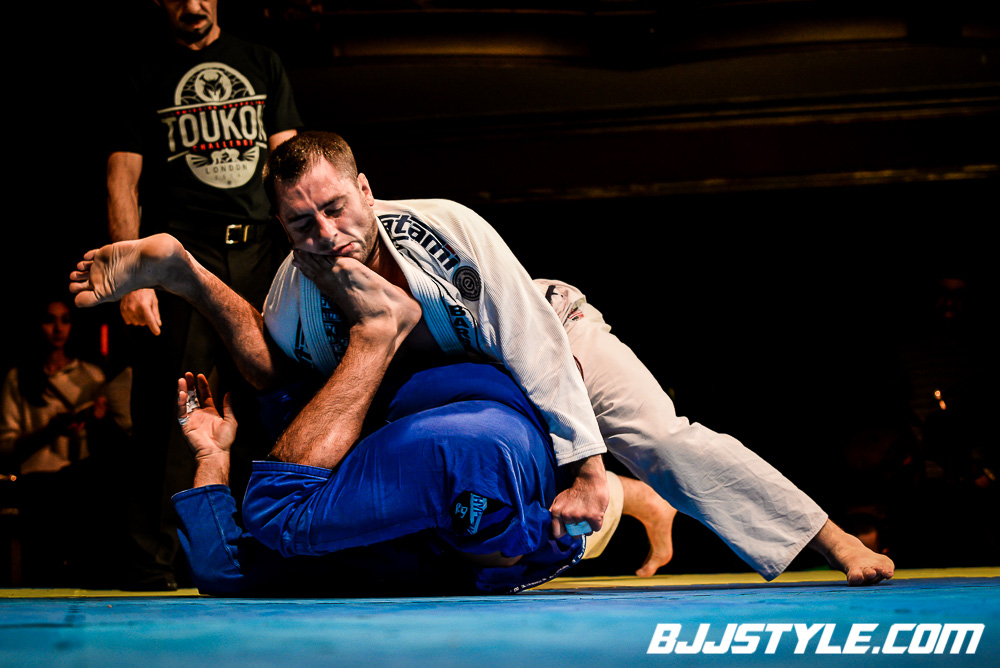
Renzo Gracie purple belt Nicholas Nahas was a good case study. When I first interviewed him, he was preparing for a submission-only Brazilian Jiu Jitsu match against Extreme Cage Combat welter weight champion and BJJ black belt Matt McGrath on June 20, 2015 in Halifax, NS. He'd only been training jiu-jitsu for about six years at that point — but he'd been a serious competitive athlete since high school.
"I was a member of the Canadian Yachting Association and received my Gold VII level," Nick told me. "I mainly raced in singlehanded dinghies. I also obtained my brown belt in Uechi Ryu Karate, competed and did well in a bunch of karate and Tae Kwon Do tournaments. Once upon a time I used to ballroom dance and I was quite competitive in that as well.
"However, I would have to say that the main sport that I played growing up was football. I would leave football practice for dance lessons and when those were over, I would head to karate. The sport that I continued the longest was football. I went on to play provincially, played varsity in university and continued playing in the UK and Australia."
It was during that university stretch that Nick first crossed paths with BJJ, but the schedule wouldn't allow it. The proper conversion happened on the other side of the world.
"It wasn't until I was living in Australia that I decided to give it another go," he said. "I was playing football in a less competitive league and found out about a club near me called Fight Club Jiu Jitsu. I didn't even remember how to do an arm bar, but jiu jitsu started to take a priority ever since my first class back."
What football actually gives you on the BJJ mats
Football is gone for Nick now — but the habits that football built are exactly the ones that translate the cleanest into Jiu Jitsu.
"Football lends a ton of great qualities to jiu jitsu," he explained. "Discipline is one of the more useful qualities you must learn in football. You have to listen to your coach or else you'll be benched or kicked off the team. It's ingrained in you to listen to your coaching. In jiu jitsu, I can hear my coaches from the sidelines when competing. A lot of people just drown out the noise but I listen for it — it really makes a difference.
"Even though you're competing individually in jiu jitsu, you almost always have other teammates competing at the same tournament. In football, you're forced to work as a team, so the whole teamwork aspect transfers over nicely — helping your teammates train and prepare for their matches, pumping them up, and overall being a positive influence for their training.
"Lastly, in football you're grinding it out for four quarters. Whether you're playing in the rain, snow, heat, mud — it doesn't matter, you're still giving it your all. You're physical and you don't quit until the last second. That grinding-it-out, don't-quit attitude is a great attitude to have for jiu jitsu as well."
If you've ever watched a wrestler walk into a BJJ gym for the first time, you've seen the same thing from a different angle. Sport background isn't a substitute for technique — but the willingness to be uncomfortable for a long time, on command, is something some athletes already arrive with.
Strength out, technique in
The mental side of football has paid dividends in BJJ. The physical side — specifically the heavy lifting required just to survive a football career — Nick was happy to leave behind.
"I believe the strength aspect is different," he said. "With football, you have to be strong. You're always in the gym and you're always lifting heavy. You're concerned and tested on how many reps of 225 lbs you can bench, what your max squat is, how much you clean, etc. There is no need to lift heavy in Brazilian jiu jitsu. There are many more attributes that will compensate for, and for the most part, defeat strength. Being strong helps, but I don't need to put my joints through fifteen reps of 225 lbs anymore. Speed, technique, flexibility, efficiency, patience — all of these are attributes that balance out and compliment strength.
"The conditioning is very similar, though. Football has many pauses; you go all out for maybe ten to fifteen seconds and have a thirty- to forty-five-second break. That cycle continues for pretty much the entire game. Jiu jitsu is similar in the sense that you're not going full tilt for the entire match. Whether you have a seven-minute match or a fifteen-minute match, it's always best to use your energy efficiently or else you'll lose your steam before the time runs out. Obviously you'll perform better in any sport if you have good cardio, but the 'playing' time between the two sports is similar for sure."
That observation has aged well. Watch any current ADCC or CJI match — even the no-time-limit ones in EBI-style overtime — and the rhythm is exactly that: high-output exchanges separated by stalled pressure and grip fighting. The athletes managing the pacing best are usually the ones who learned to manage it in another sport first.
The part of football he was glad to walk away from
Then there's the part of football you can't out-train, no matter how smart your strength and conditioning program is: the repeated small blows to the head that accumulate over a career. Occasionally in BJJ a random head-butt will make you wince, but in football, players can accumulate hundreds of subconcussive impacts in a single season — and the long-term cost is now much better understood than it was eleven years ago, when we first had this conversation.
"The correlation between football and brain damage is scary," Nick said. "I was fortunate enough to never incur a concussion, but it was very common for players to become concussed, take a few plays off, and then get back on the field and finish the game — and that was at the high school and university level. These guys weren't even getting paid.
"I would say, hands down, there are far more injuries — and far more serious injuries — in football than in MMA or jiu jitsu. From personal experience, I've torn my ACL and had reconstructive surgery to shorten the tendons in my shoulder as a result of football. The only injuries I've had from training MMA or jiu jitsu are bangs and bruises and maybe the odd hyperextended limb.
"In my opinion, football is far more dangerous. Obviously serious injuries can occur in any sport no matter how smart you train, but you are more likely to receive serious injuries in football because of the nature of the sport. A game is 60 minutes long and you're running full tilt against someone with the intention of knocking them down."
Since 2015, CTE research out of programs like Boston University's has only made that picture starker — current and retired NFL and college players are diagnosed with chronic traumatic encephalopathy at rates that would close down most other workplaces. Brazilian Jiu Jitsu isn't risk-free, but the risk profile is fundamentally different: orthopedic and avoidable, not neurological and cumulative.
No regrets, but a different plan for the next generation
The Submission Series Pro match against McGrath came and went. Sub-only Jiu Jitsu, which still felt novel and slightly outlaw in 2015, has become a whole pillar of the sport — CJI, ADCC, WNO, Tezos WNO, Polaris and a half-dozen smaller promotions are all live on FloGrappling or UFC Fight Pass on any given weekend now. Athletes like Nick, who came up valuing the finish over the points, have aged into the perfect moment for their style.
Looking back, though, Nick still wouldn't trade football for BJJ if he had to choose.
"I don't think I would have chosen BJJ over football, but I definitely would have stopped playing football earlier, started BJJ earlier and stuck with it," he said. "Both sports have great qualities, teach great lessons and discipline. I've made lifelong friends through both sports. I can't say I would never have played football, but that's just because I've had such a positive experience with it."
When we first talked, Nick had just gotten married and was thinking about a family. I asked him what he'd want his kids to play, athletically.
"I ask myself this question all the time," he said. "I always thought I would like my kids to play football, but I've been second-guessing that thought with all the concussion concerns. I will 100% encourage jiu jitsu and start my kids off as soon as I can, but I am not settled on football at this point."
I suspect a lot of former football players are landing in exactly the same place now — encouraging their kids onto a Brazilian Jiu Jitsu mat, where the worst day is usually some mat burn and a sore neck, and saving the football conversation for later. The kids who come up that way are going to be terrifying purple belts in about a decade.
If you're a wrestler, a footballer, a rugby player, a judoka, or any other late convert reading this — the takeaway is the simple one: bring the work ethic, leave the macho strength obsession at the door, and let the technique catch up. The mats reward it. As always, I'll see you on them.
Originally published in Jiu Jitsu Style by Sally Arsenault. Refreshed for 2026.