Buchecha's Rolling Armbar: A BJJ Breakdown
Marcus "Buchecha" Almeida's rolling armbar on Roger Gracie at Metamoris was one of the sharpest entries of its era, and the tutorial where he breaks it down still solves the same problem it solved…
Words: Jiu Jitsu Style
Marcus "Buchecha" Almeida's rolling armbar on Roger Gracie at Metamoris was one of the sharpest entries of its era, and the tutorial where he breaks it down still solves the same problem it solved on that stage. Almeida, one of the best heavyweights BJJ has ever produced, has since traded IBJJF gold for an MMA run, but the roll he was teaching hasn't aged a day.
Watch it: Buchecha's rolling armbar.
If you weren't glued to a laptop for Metamoris in 2012, the short version is this: two of the finest gi grapplers of the era, Buchecha and Roger Gracie, went twenty minutes without a finish, and one of the sharpest moments in that match was Buchecha spinning underneath for an armbar. He didn't get the tap, Roger's defense is the stuff of legend, but the entry was clean enough that people were still asking how he did it four years later. Hence the tutorial.
Why the Rolling Armbar Still Belongs in Your Jiu Jitsu
The rolling armbar looks flashy, and that flash is exactly why beginners misread it. They see the somersault and assume the magic is in the roll. It isn't. The roll is just the delivery system. What makes the attack work is that it turns your opponent's forward pressure into your submission, when a passer drives their weight over the top to flatten you out, you feed that momentum, spin underneath the arm they've committed, and let their own drive rotate you straight into the finishing angle.
That's why it suited Buchecha so well, and why it survives translation to anyone's game. He spent his whole career being the biggest, strongest man in the bracket, but the rolling armbar runs on timing rather than strength. You're not muscling the arm free. You're catching the instant your opponent over-commits their base and borrowing the energy they've already spent. Strip Buchecha's name off it and the lesson is pure Brazilian Jiu Jitsu: the best submissions are harvested from what the opponent is already giving you rather than imposed on a resisting one.
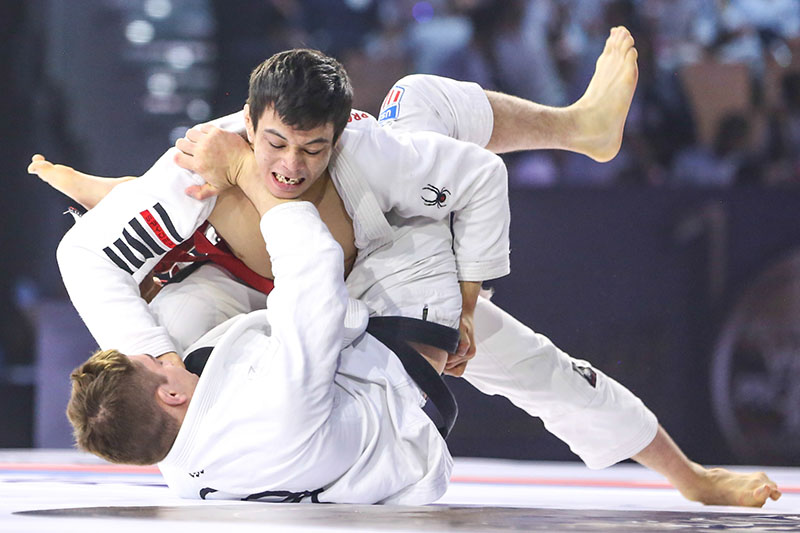
Drilling the Roll Without Breaking Your Neck
Here's the honest warning the original one-liner skipped: the rolling armbar is a shoulder-roll under load, and if you throw it cold at full speed you'll teach yourself bad habits at best and tweak your neck at worst. Drill it in layers. Start with the shoulder roll on its own, no partner, until tucking your chin and rolling over the back of your shoulder feels automatic. Then add a compliant training partner who gives you the forward pressure but lets you find the arm slowly. Only once the path is grooved do you crank up the resistance.
The details that decide it are small and unglamorous. Trap the arm before you spin, not during, if the elbow isn't yours before you commit to the roll, you're just doing a somersault into open guard. Keep your knee pinching across their back as you rotate so the arm can't slide out mid-roll. And finish tight: pinch your knees, control the wrist, and raise the hips slowly rather than yanking. The roll gets you the angle; the finish is still an ordinary armbar, and ordinary armbars reward patience.
What the Modern BJJ Game Did With the Same Idea
Watch a decade of Jiu Jitsu since this clip went up and you'll see the rolling attack everywhere, sharpened and re-packaged. Mikey Musumeci threads inverted, rolling entries into his arm and leg hunts until the defense runs out of directions to travel. The Ruotolo brothers treat a scramble as an invitation, spinning under and over their opponents at a pace that would have looked reckless in 2012. Even in the leg-lock era, the principle Buchecha was teaching, invert, borrow the momentum, catch the joint mid-motion, is the same one underpinning a hundred modern entries. None of them invented it. They're doing at speed what he walked through slowly for a camera.
The tooling has changed more than the technique has. In 2016 you found a breakdown like this because a magazine posted it and you happened to be scrolling; in 2026 there's a multi-hour instructional on rolling attacks for every body type, and the apps will queue up a dozen before you've finished tying your belt. What none of that gives you is the reps. So take the boring half into the gym: roll, trap, pinch, finish, over and over, until the flashy version stops feeling flashy and starts feeling like yours.
Then go back and watch the old Metamoris scramble one more time and notice that one of the greatest to ever do it had already shown you the whole thing in a single quiet minute of footage.
See you on the mats.
Originally published on Jiu Jitsu Style, 11 May 2016. Refreshed for 2026.