BJJ Lessons We Can Learn From Kids
Jiu Jitsu has a funny way of flipping the script. For the most part, kids are supposed to learn from adults — they're told to listen, for their own good, to the wisdom that adults have acquired…
About the author: Sam Joseph is a second-degree black belt, head instructor and owner of Buckhead Jiu Jitsu in Atlanta.
Jiu Jitsu has a funny way of flipping the script. For the most part, kids are supposed to learn from adults — they're told to listen, for their own good, to the wisdom that adults have acquired through experience tempered with greater maturity. BJJ turns that around: it offers adults the chance to take direction from the kids, because there are some real advantages to looking at Brazilian Jiu Jitsu through "child-like" eyes. Let's explore some of the ways we can enhance our own BJJ experience by learning from kids and their points of view!
Kids have "short memories"
BJJ can be very frustrating and even discouraging. A tough training session or a disappointing performance at a tournament can leave us feeling down on ourselves and on our level of jiu jitsu. Even the most talented and positive of us sometimes feel like our games have regressed and aren't advancing at the rate we want. The problem is that, as adults, we tend to dwell on these things, which lets them take root and grow into real issues that do even more damage to our BJJ.
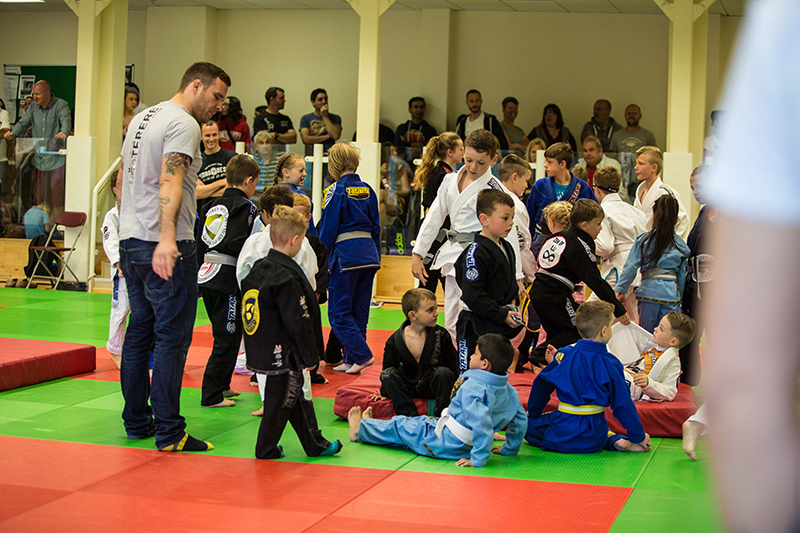
Kids have a gift that gives them a leg up in these situations: the short memory. In our Kids' BJJ class at my academy, I have to deal with many a "crying child" over losing a round of sparring, performing poorly in a game, not being picked to demonstrate a drill, or taking a knock while training. Sometimes there's even anger at me or another student adding to the intensity of it. The great thing is that most of the time, if we fast-forward five minutes, those same kids are smiling, laughing and enjoying class!
Kids have this incredibly useful ability to "bounce back" from frustrating situations, set them aside and get right back to having fun. To be fair, they often need adult help to stop focusing on what started the tears, but once they get that direction they put it behind them in a way most of us should envy. By choosing to move forward and leave the negative behind, kids open themselves up to the positive things and good times waiting for them. When we manage to mimic kids in this, we find our own fun and often walk straight through the door to improvement in our games.
Kids are competitive without being adversarial
I have two nieces and a nephew who train BJJ. When I see the younger two, whether we're on a mat or in a living room, the first thing they want to do is see if they can finally out-grapple me. They try to take me down, attack my back, pass my guard. The engagements always end with me winning via submission-by-tickling, but I often see HUGE improvements in their games as they learn more BJJ and mature. The best part is that once we're done "competing," they're all smiles and I'm "Uncle Sam" again instead of the "enemy." We enjoy each other's company without any reservation about the fact that we just sparred and will spar again soon.
When we as adults get competitive on the mat, even with training partners, it often borders on adversarial. I've seen many "academy rivalries" wreck what could have been tremendous training relationships, because one or both people let training cross the invisible line separating "healthy competition" from "taking it too personally." Kids intuitively understand the difference, and if we can follow their lead, we get to keep a training environment that's competitive AND healthy.
Kids enthusiastically test their limits
The kids at my academy provide a great example of the next point: they enthusiastically test their limits on the mat. Whether we're sparring, drilling throws or playing balance-ball games, the kids are constantly pushing to get better, do better, and beat the instructor. The enthusiasm they bring gives them what seems like unlimited energy, and that energy is FUEL for the "improvement machine." When we as adults emulate that approach and dive into training with the same child-like passion, it always pays off. If nothing else, it makes it easier to spend more quality time on the mat, and that alone helps us improve.
There's a bonus, too: that kind of positive energy is contagious. It moves from student to student like wildfire and very quickly creates an atmosphere that's empowering and inclusive. Again, it all starts with coming to the mat ready to enthusiastically test ourselves.
Kids are wide-eyed about Jiu Jitsu
Have you ever watched an instructor show kids a new move? It's a joy to see how they light up at something new, or when they pull off something they've just been shown. The world of BJJ is so BIG to them, and they seem to appreciate that vastness in a way that can energize an entire room. When we allow ourselves that same raw appreciation for the new techniques, concepts and strategies we learn, we unlock real energy that supports genuine advancement in our own games. The beauty of it is that, as more mature beings, we can have an even GREATER appreciation for the little details that make huge differences in BJJ.
We're also blessed to live in a time where the whole BJJ world is right there in our pockets. Between watching the best competitors on the planet — Gordon Ryan, Mikey Musumeci, the Ruotolo brothers, Ffion Davies — break down their matches on YouTube, and the deep instructional libraries on apps like BJJ Fanatics, we have endless footage and ideas to entertain us, build our individual jiu jitsu, and challenge and inspire us. A wide-eyed kid would be in heaven with that kind of access; we'd do well to approach it the same way instead of doom-scrolling past it.
Kids don't take themselves too seriously
For me, this is the most important lesson we can learn from how kids approach the mat. I've watched many talented athletes slow their own progress by taking themselves too seriously and refusing to enjoy the BJJ journey. In 2001, I'd been a blue belt for two years and had enjoyed some success in regional and international tournaments. I thought I was getting close to my purple belt, and something interesting happened: I stopped enjoying BJJ, because all I was focused on was getting promoted. I remember being uptight in training and hindering my own performances in a couple of tournaments because I was thinking about what I had to lose. It was the height of arrogance, in retrospect — I was acting like the BJJ world revolved around me, and in doing that I robbed myself of months of real fun and potential progress. Fortunately, when I finally received my purple belt, I regained a healthy sense of humor and perspective. They, and my instructors, helped me smile regularly in training and start seeing tournaments as tools to get better rather than as a verdict on my worth.
Kids just seem to "get" this. They laugh at themselves easily in training, and they don't let BJJ obstacles stop them. Kids trip and hit the ground just like we do, but they find the humor in it in a way that takes the sting out of the fall. That ability — to laugh at yourself and carry on — is like water in a desert. It's priceless.
All in all, kids have a great deal to teach us about how to best navigate the BJJ journey. If we listen, we'll be the better for it and get the most out of the BJJ lifestyle. See you on the mat!
Originally published in Jiu Jitsu Style by Sam Joseph. Refreshed for 2026.