BJJ Concepts for Everyday Life
Brazilian Jiu Jitsu, as a sport and a lifestyle, has a significant impact on the people who train it. We reach higher levels of fitness while learning to control our bodies and those who come into…
About the author: Sam Joseph is a second-degree black belt, head instructor and owner of Buckhead Jiu Jitsu in Atlanta.
Brazilian Jiu Jitsu, as a sport and a lifestyle, has a significant impact on the people who train it. We reach higher levels of fitness while learning to control our bodies and those who come into physical contact with us. Those results are expected. What gets less attention is how the core CONCEPTS of BJJ — the things that make the sport work — quietly start to shape the rest of our lives too. Let's look at a few of those concepts, how training cultivates them in us, and the value they carry beyond the mat.
Be the last person to accept defeat
The 2012 edition of the Mundials is mostly remembered as the event that crowned Buchecha. The Checkmat athlete won both his division and the openweight, starting his reign as the king of BJJ. For me, even more than the fact that Buchecha won, it was the WAY he won two of his toughest matches that day that stands out. Against Rodolfo Vieira and Leo Nogueira, Buchecha was down on points with under a minute left and secured the win by exploding for takedowns. He won those fights when most people watching had already concluded he was surely going to lose. He did not quit. That "never say die" attitude let him snatch victory from the jaws of defeat because he was the last person in the building to know he had "lost."
You see the same trait running through the current generation. Nicholas Meregali has built a habit of pulling matches back from the brink in the closing seconds. Mikey Musumeci, who spent years being told he was too small and too unorthodox to win at the very top, kept showing up anyway and is now a multiple-time IBJJF world champion and ONE Championship gold medalist. The story keeps repeating because the principle is the same — the athlete who refuses to write themselves off tends to be the one still standing at the end.
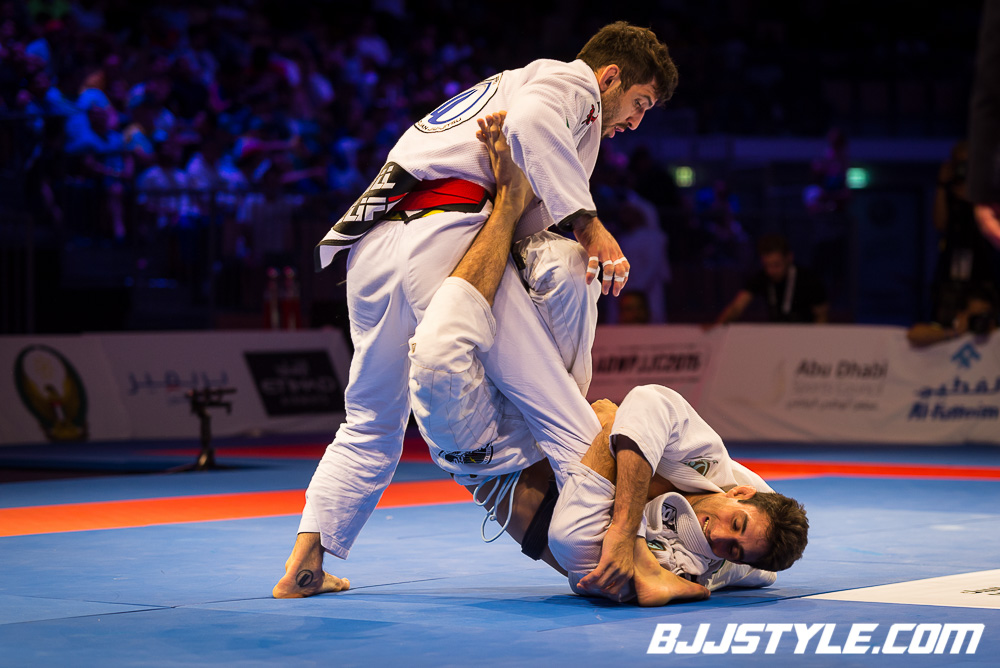
When we adopt this attitude, we're not just mimicking Buchecha; we're applying a core concept of BJJ. The very nature of the guard is taking a position that common knowledge calls weak — being on the bottom in an altercation — and turning it into a place where we can protect ourselves and even attack. Like a lot of people, I was first drawn to BJJ by Royce Gracie's exploits in winning three of the first four UFCs. What cemented my interest was his fight against Dan Severn at UFC 4. I, along with the announcers, thought Severn was on his way to victory when Royce won via triangle choke. Royce was being smothered and pounded by a wrestler one hundred pounds heavier, and when everyone — except presumably Royce and his family — thought he was on his way to defeat, he won in convincing fashion. That commitment to moving forward, even in bad situations, is part of the BJJ mentality we cultivate in ourselves as we train and grow in the sport.
Be calm in the eye of the storm
Roger Gracie is known as one of the greatest BJJ athletes of all time. The multiple-time Mundial champion has a reputation as a finisher, even at black belt. What often gets overlooked is his mastery of DEFENCE. The fact that Roger has never been submitted as a black belt is no accident, and his defence is something interviews reveal he takes well-earned pride in. He put himself in the "storm" deliberately, by training with the toughest partners he could find in the academy as he progressed through the ranks. That experience, and the technical points he learned in those rounds, allowed him to develop genuine confidence in his ability to escape tough positions against the very best fighters in the world. Watching matches like his 2004 Mundial encounter with Fernando Terere or his 2007 showdown with Fernando "Margarida" Pontes, you see Roger stay calm when put in tough spots and then go on to win decisively.
You see the same composure in the current crop. Ffion Davies in a hard scramble, the Ruotolo brothers in a leg entanglement against an elite back-taker, Gordon Ryan in trouble for a brief moment in a submission-only match — the heart rate doesn't spike, the breathing stays even, and the answer comes from training rather than panic. That is what calm under fire actually looks like.
Our ability to stay cool under fire is often a huge factor in determining our success in any situation. When we master the ability to stay calm, we give ourselves the chance to put our full mind to solving the problem in front of us. BJJ is a great tool for teaching and honing that skill.
Weaknesses are opportunities
Like a lot of people, when I started BJJ I was most comfortable on top. As a new blue belt who wanted to compete, I was faced with the reality that my guard game was limited and needed serious work. I was unsure how to get better until I got some advice from long-time training partners Paul Creighton and Brad Adams — both blue belts at the time but with about a year of mat experience on me (both are currently BJJ black belts). They told me to look at my "weakness" as an opportunity for improvement and to put together a daily plan to work on that specific area. After hearing that, I started staying after class with them to do guard retention and sweep drills that I still do to this day. I went from a new blue belt who was scared of being on the bottom to one who was comfortable wherever the match took me. That gave me much more rounded BJJ and has been a key part of my success ever since.
The tools we have now make this kind of targeted work easier than it has ever been. Pick a position you struggle with, queue up a couple of instructionals on BJJ Fanatics or a strong free YouTube channel, write down the two or three details that jumped out, then take them straight into open mat. My "weakness" was, in truth, a real opportunity to make a massive improvement based on the actions I took. The upside of applying that idea in other parts of our lives is obvious. Turning weaknesses into strengths in any situation will let us reap rewards otherwise out of reach in those areas.
Jiu Jitsu improvement comes in small steps
As a purple belt, I remember a particularly humbling training session at the Yamasaki Academy with Murilo Santana. Mario Yamasaki, who watched as Murilo completely shut down my game and tapped me, came over to where I was licking my wounds and said something I often repeat to my own students today. "Little details," Mario said. "Your jiu jitsu is very good — you're just missing the little details to connect it." At the time, while I appreciated the kind words, I thought Mario was crazy, because the only thing Murilo had left me feeling "very good" at was getting my guard passed and tapping. I respected Mario, so I held on to what he said, and over time I came to understand the truth in it. I was missing technical details that Murilo was taking advantage of, and the key to my improvement was understanding those details and making the corrections.
Mario's coaching was the seed of a mantra I often quote: "Little details lead to huge improvements." When we approach the mat with that mindset, we become hyper-aware of the details. The details stack, compound, and lead to real improvement in our games. BJJ gives us an appreciation for the incremental progress that often marks real growth — five degrees of grip angle, half a second earlier on a frame, a foot on the hip instead of next to it. Applying that concept in other places in our lives supports continued improvement, because it protects us from the stagnation that can come from a perceived lack of progress.
The concepts in this piece are not exclusive to Brazilian jiu jitsu. What BJJ does is reinforce, day after day, how the APPLICATION of these concepts pays off. That kind of compounded learning lets them take real root, which makes it easier to apply the same lessons in other areas of our lives. When we do that, we are truly enjoying the benefits of the BJJ lifestyle we have chosen.
See you on the mat!
Originally published in Jiu Jitsu Style by Sam Joseph. Refreshed for 2026.